How Often to Mow Your Lawn: A Homeowner’s Guide for 2026

TL;DR
- Most lawns need mowing once per week during the active growing season (spring and summer).
- The correct frequency depends on grass type, season, temperature, and how much rain or fertilizer the lawn receives.
- The one rule that applies to every lawn: never cut more than one-third of the grass blade in a single mow.
- In fall, mowing drops to every 10 to 14 days. In winter, most cool-season grasses stop growing entirely.
- Mowing too often stresses the grass; mowing too rarely lets it grow tall and puts strain on the mower.
How Often Should You Mow Your Lawn?
Most residential lawns need mowing once a week during spring and summer. That is the baseline for a healthy, actively growing lawn in a temperate climate. The actual number can shift up or down based on your grass type, the season, recent rainfall, and whether you have fertilized recently – but once a week is the right starting point for the majority of homeowners.
The most reliable guide is not a calendar – it is the grass itself. When your lawn has grown one-third above its ideal height, it is time to mow. That single principle, known as the one-third rule, governs mowing frequency more accurately than any fixed schedule.
What Is the One-Third Rule and Why It Matters
The one-third rule states that you should never remove more than one-third of the grass blade in a single mowing session. It is the most widely agreed-upon guideline in turf management, cited by the University of Minnesota Extension (2026) and virtually every state cooperative extension program in the United States.
Here is why it matters in practical terms. If your grass type performs best at 3 inches, you should mow when it reaches 4.5 inches – not before, not significantly after. Cutting more than one-third at once sends the plant into stress recovery mode. The grass diverts energy from root development to replacing lost leaf tissue, which weakens the root system over time and makes the lawn more vulnerable to drought, disease, and weed invasion.
Cutting too little of the blade at each session is less damaging but still counterproductive. It means you are mowing more often than necessary, which compacts the soil with mower traffic and gives weeds more opportunities to establish between passes.
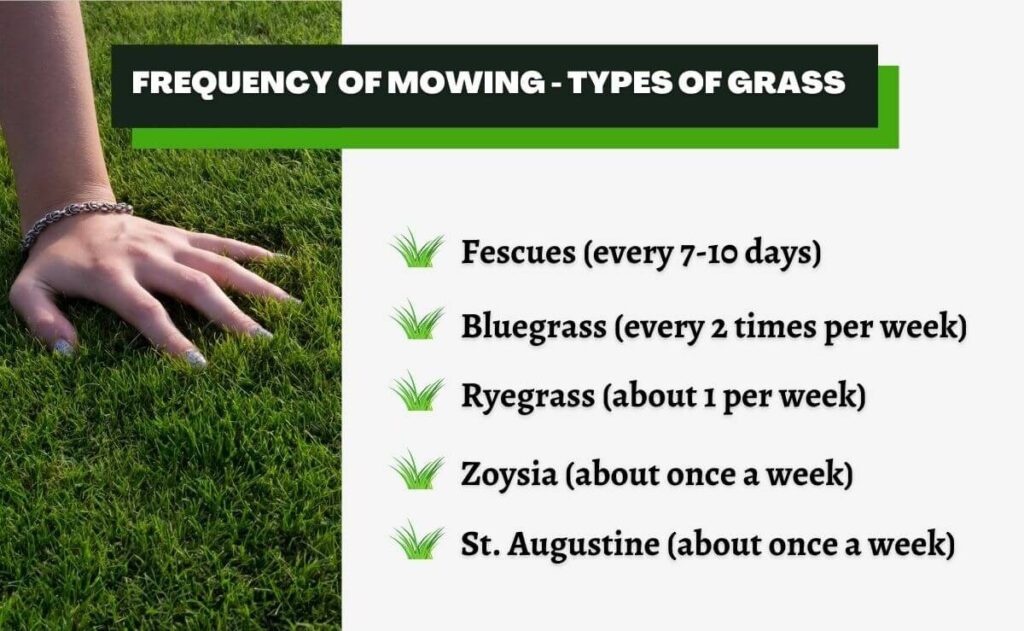
How Often to Mow by Grass Type
Different grass types grow at different rates. Mowing frequency should match the growth rate of your specific grass, not a generic calendar.
| Grass Type | Ideal Height | Mow When It Reaches | Typical Frequency (Peak Season) |
|---|---|---|---|
| Kentucky Bluegrass | 2.5 – 3.5 in | 3.75 – 5.25 in | Every 5 – 7 days |
| Tall Fescue | 3 – 4 in | 4.5 – 6 in | Every 7 – 10 days |
| Bermuda Grass | 1 – 2 in | 1.5 – 3 in | Every 5 – 7 days |
| Zoysia Grass | 1 – 2.5 in | 1.5 – 3.75 in | Every 7 – 14 days |
| St. Augustine Grass | 3 – 4 in | 4.5 – 6 in | Every 7 – 10 days |
| Centipede Grass | 1.5 – 2 in | 2.25 – 3 in | Every 7 – 14 days |
Warm-season grasses like Bermuda and Zoysia grow fastest in summer heat and slow sharply once temperatures drop below 60°F. Cool-season grasses like Kentucky Bluegrass and Tall Fescue peak in spring and fall and go semi-dormant in summer heat. Matching your mowing schedule to those growth cycles – rather than mowing on a fixed weekly schedule regardless of season – is what separates a healthy lawn from a stressed one.
How Often to Mow by Season
Grass growth is not consistent across the year. A fixed once-a-week schedule works well in peak growing months but becomes too frequent in slow seasons and not frequent enough during growth surges after rain or fertilization.
Spring (March – May). This is the fastest growth period for cool-season grasses. Mow every five to seven days, and expect to need extra passes after heavy rain or a fertilizer application. Do not skip mows during this period – letting grass get tall in spring leads to scalping when you finally do cut it.
Summer (June – August). Cool-season grasses slow down in heat above 85°F and may go semi-dormant. Drop to every 10 to 14 days or stop mowing entirely if the grass stops growing. Warm-season grasses hit their peak in summer – maintain a weekly schedule. Raise the cutting height by half an inch during heat waves to reduce stress on the turf.
Fall (September – November). Cool-season grasses get a second growth surge as temperatures drop. Return to weekly mowing. Warm-season grasses begin slowing down. Reduce mowing frequency to every 10 to 14 days by late October.
Winter (December – February). Most cool-season grasses go dormant and do not need mowing. Warm-season grasses in frost-free climates may still need occasional mowing every three to four weeks. Do not mow dormant grass – it causes unnecessary stress and can damage the crowns.
How Fertilizer and Rain Affect Mowing Frequency
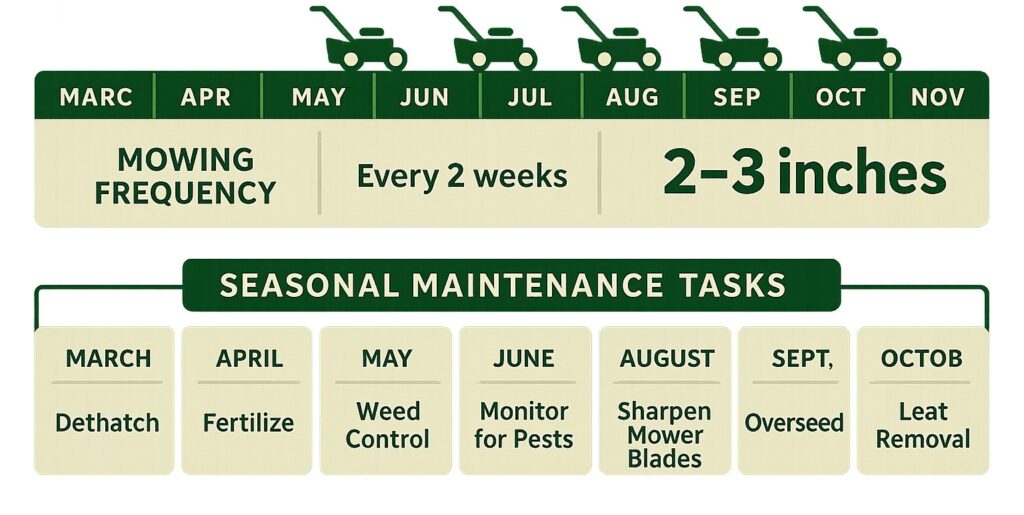
Two factors push mowing frequency up faster than anything else: fertilizer and rainfall.
A nitrogen fertilizer application accelerates leaf growth noticeably within five to seven days. If you fertilize in spring or early summer, expect to mow more often for the following two to three weeks – possibly every five days instead of seven. According to Purdue University Extension (2026), a single application of quick-release nitrogen can increase grass growth rate by 30 to 50 percent in the week following application.
Heavy rainfall has a similar effect. A week of consistent rain during the growing season can push a lawn from needing a mow every seven days to needing one every four or five. Check the lawn two to three days after significant rain rather than waiting for your usual schedule.
The reverse is also true. During drought or dry spells, grass growth slows considerably. Mowing every 10 to 14 days – or not at all if the grass has stopped growing – is the right call when the lawn is dry and under heat stress.
Signs You Are Mowing Too Often
- Grass blades look thin and pale between mowing sessions.
- The lawn has visible wheel ruts from repeated mower passes on the same tracks.
- Bare patches appear where the soil is being compacted by frequent mower traffic.
- The grass feels spongy rather than firm underfoot.
If you notice any of these, extend the interval between mows by two to three days and raise the cutting height by half an inch.
Signs You Are Not Mowing Often Enough
- Grass is visibly flopping or leaning sideways rather than standing upright.
- The mower bogs down or stalls when you try to cut – a sign the grass is too tall for a single pass.
- After mowing, the lawn looks yellow or brown on top. This is called scalping and happens when you cut into the lower, less-photosynthetically active part of the blade.
- Clumping is heavy even though the grass is dry – a sign the volume of clippings is too high for the mower to distribute evenly.
If the grass has gotten too tall for a single mow, raise the cutting height and take two passes two to three days apart rather than cutting it all at once.
Common Mistakes Homeowners Make with Mowing Frequency
- Mowing on a rigid schedule regardless of growth. Mowing every Saturday whether the grass needs it or not leads to cutting too short in slow periods and falling behind during growth surges. Let the grass height guide the schedule.
- Cutting too short to mow less often. Cutting grass very short – called scalping – does not reduce mowing frequency in any meaningful way. It stresses the grass, exposes the soil to weed seeds, and increases water loss. Maintain the recommended height for your grass type.
- Stopping mows too early in fall. The last mow of the season should leave cool-season grass at its ideal height, not taller. Grass left too long going into winter is more susceptible to snow mold and matting.
- Mowing dormant grass in winter. Dormant grass does not need cutting. Running a mower over dormant turf compacts the soil and can damage crowns that are already stressed by cold.
Frequently Asked Questions About Lawn Mowing Frequency
How often should you mow your lawn?
Once a week is the right baseline for most lawns during the active growing season (spring and summer). The exact frequency shifts based on grass type, season, rainfall, and fertilization. The one-third rule – never cut more than one-third of the blade at once – is a more reliable guide than any fixed schedule.
Is it okay to mow the lawn every two weeks?
Every two weeks is acceptable in slow growth periods – late fall, summer dormancy for cool-season grasses, or during drought. During active spring and summer growth, a two-week gap typically means the grass has grown too tall for a clean cut without stressing the plant. If you miss a week, raise the cutting height and take two passes a few days apart.
What happens if you mow too often?
Mowing too often – especially cutting too short each time – weakens the root system because the grass constantly redirects energy to regrowing leaf tissue instead of developing roots. It also compacts the soil with repeated mower traffic and can thin out the turf over time, leaving gaps where weeds establish.
Should I mow more after fertilizing?
Yes. A nitrogen fertilizer application increases leaf growth rate by 30 to 50 percent in the week following application (Purdue University Extension, 2026). Expect to mow every five days instead of seven for the two to three weeks after fertilizing during the growing season.
What is the best height to cut grass?
The ideal cutting height depends on grass type. Most cool-season grasses perform best at 2.5 to 4 inches. Most warm-season grasses perform best at 1 to 2.5 inches. As a general rule, raise the cutting height by half an inch during summer heat waves and drought to reduce stress on the turf.
Should I mow my lawn in winter?
In most climates, no. Cool-season grasses go dormant in winter and do not need mowing. Warm-season grasses in frost-free regions may need an occasional mow every three to four weeks if they are still showing active growth. Never mow grass that is visibly dormant – brown, dry, and not growing.
Key Takeaways
- Once a week is the right mowing frequency for most lawns during spring and summer.
- Use the one-third rule as your primary guide: mow when the grass reaches one-third above its ideal height.
- Warm-season and cool-season grasses have different growth cycles – match your schedule to your grass type, not just the calendar.
- Fertilizer and heavy rain push growth rates up significantly; reduce the interval between mows when either occurs.
- Drop to every 10 to 14 days in fall, and stop mowing entirely when the grass goes dormant in winter.