The Right Way to Water Grass for Healthy Growth

TL;DR
- Water deeply and infrequently – 1 to 1.5 inches per week, split across 2-3 sessions
- Early morning (5-9 AM) is the best time to water; evening watering promotes fungal disease
- Water to a 6-inch soil depth to encourage deep root growth
- Most lawns need water only when grass blades start to fold or footprints stay visible
- Overwatering is as damaging as underwatering – more lawns die from too much water than too little
How Much Water Does Grass Actually Need Each Week?
Most grass types need 1 to 1.5 inches of water per week, from rain, irrigation, or both (University of California Cooperative Extension, 2023). That figure holds for the majority of cool-season grasses like tall fescue and Kentucky bluegrass, and most warm-season grasses like Bermuda and Zoysia during active growth periods.
The mistake most homeowners make is watering lightly every day. Short, shallow watering keeps moisture in the top inch of soil, which trains roots to stay near the surface. Shallow roots make grass more vulnerable to heat, drought, and foot traffic. Deep, infrequent watering pushes roots down 6 inches or more, where soil stays cooler and moisture lasts longer.
A simple way to measure: set an empty tuna can or straight-sided cup in your sprinkler zone. When it holds half an inch of water, you’ve run that zone long enough for one session. Two sessions per week gets you to the 1-inch target.
What Time of Day Should You Water Your Lawn?
Water between 5 AM and 9 AM. This is the single most important timing rule for lawn health.
Morning watering gives grass blades time to dry before temperatures rise. Wet blades sitting through the heat of the day or overnight are the primary condition for fungal diseases like brown patch and dollar spot (Penn State Extension, 2022). Those diseases are expensive to treat and easy to prevent by watering at the right time.
Midday watering wastes water to evaporation – the EPA WaterSense program estimates up to 30% of water applied midday is lost before it reaches the root zone (EPA WaterSense, 2023). Evening watering leaves blades wet overnight, which is the ideal environment for fungal growth.
If your schedule makes morning watering impossible, midday is the second choice – not ideal, but better than evening.
How Long Should You Run Your Sprinklers?
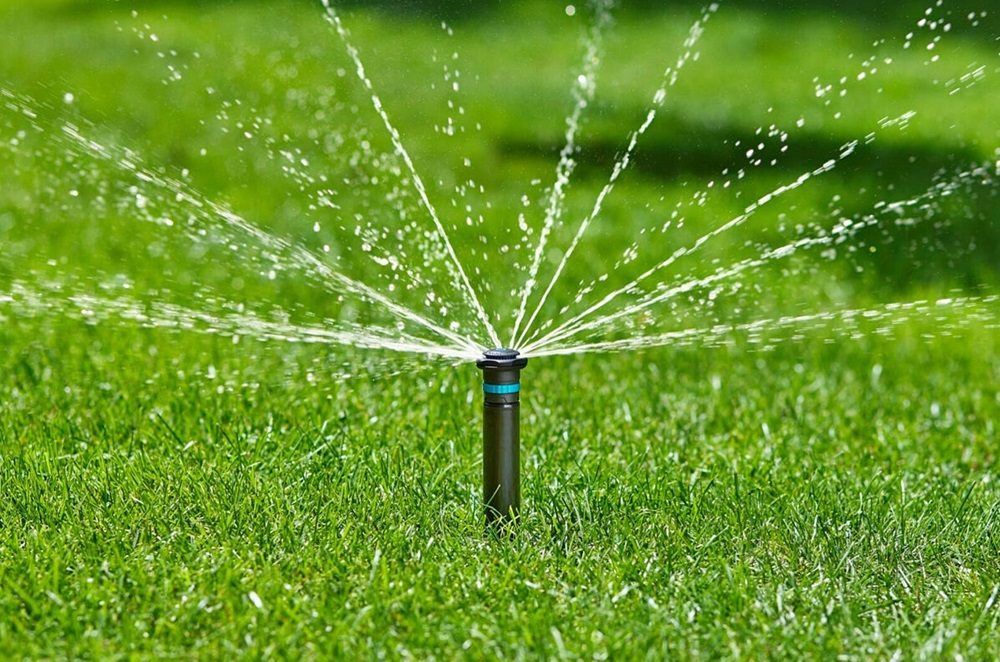
Run time depends on your sprinkler output, not a fixed number of minutes. Most standard rotary sprinkler heads put out 0.5 to 1 inch of water per hour. Most fixed spray heads deliver 1.5 to 2 inches per hour (Rain Bird Irrigation Guide, 2023).
Use the tuna-can test to measure your actual output before setting a timer schedule. Place 4 to 6 cans across a sprinkler zone and run the system for 15 minutes. Measure the average depth in the cans, then calculate how long it takes to deliver half an inch. That is your target run time per session.
For a zone running a typical rotary head at 0.75 inches per hour, you need about 40 minutes per session to deliver half an inch. A spray head at 1.5 inches per hour reaches half an inch in about 20 minutes.
| Sprinkler Type | Output Per Hour | Time to Deliver 0.5 Inches |
|---|---|---|
| Rotary head | 0.5 – 1 inch | 30 – 60 minutes |
| Fixed spray head | 1.5 – 2 inches | 15 – 20 minutes |
| Oscillating hose sprinkler | 0.5 – 0.75 inch | 40 – 60 minutes |
| Drip irrigation | 0.25 – 0.5 inch | 60 – 120 minutes |
How to Tell When Your Lawn Actually Needs Water

Grass tells you when it’s thirsty before it turns brown. Two reliable signs that it’s time to water:
Footprint test: Walk across your lawn. If your footprints stay visible for more than 30 seconds, the grass blades lack the moisture to spring back. Water within the next 12 to 24 hours.
Blade folding: Grass blades fold lengthwise along the center when the plant is conserving moisture. This is visible as a slight darkening and a change in texture across the lawn surface.
Watering on a fixed calendar schedule regardless of rainfall or soil condition is one of the most common causes of overwatered lawns. A soil moisture meter ($15-$40 at most garden centers) takes the guesswork out entirely. Probe to 3-4 inches – if the reading is in the dry range, water. If it shows moist, skip that session.
Cool-Season vs. Warm-Season Grass: Does Watering Change?
The 1 to 1.5 inch weekly target applies to both, but timing through the year differs.
Cool-season grasses (tall fescue, Kentucky bluegrass, perennial ryegrass) go semi-dormant in peak summer heat. Reduce watering slightly during dormancy – just enough to keep the crowns alive, roughly 0.5 inches per week – then return to the full schedule when temperatures drop below 85°F in late summer (Purdue University Turfgrass Science, 2022).
Warm-season grasses (Bermuda, Zoysia, St. Augustine, centipede) are most active in summer and need the full 1 to 1.5 inches per week during June through August. These grasses go naturally dormant in winter and need no irrigation once dormancy sets in.
Common Watering Mistakes That Stress Your Lawn
- Watering every day in small amounts: Keeps roots shallow and increases disease pressure. Switch to 2-3 deep sessions per week.
- Running all zones for the same amount of time: Shaded areas need less water than full-sun zones. Adjust each zone individually.
- Ignoring rainfall: One inch of rain counts toward your weekly total. Use a rain gauge or a smart controller like the Rachio 3 that pauses automatically after measurable rain.
- Watering slopes at full speed: Water runs off before it soaks in. Use a cycle-and-soak schedule – run the zone for 5-7 minutes, pause for 30 minutes, then run again.
- Keeping the same schedule year-round: Grass water needs drop by 50% or more in spring and fall compared to summer peak demand.
Frequently Asked Questions
How often should you water grass?
Water 2 to 3 times per week during the growing season, delivering a combined 1 to 1.5 inches total. Daily watering in small amounts promotes shallow roots and increases the risk of fungal disease.
What is the best time of day to water a lawn?
Between 5 AM and 9 AM. Morning watering allows grass blades to dry before midday heat, which reduces fungal disease risk and limits water loss to evaporation.
How deep should water soak into the soil?
Water should reach 6 inches deep to encourage deep root growth. Push a screwdriver into the soil after watering – if it slides in easily to 6 inches, you’ve watered enough.
Can you overwater grass?
Yes. Overwatering suffocates roots by pushing oxygen out of the soil, and it creates the wet conditions that fungal diseases need to spread. If your lawn has soggy patches, mushrooms, or a persistent sour smell, you are watering too much.
Does grass need water in the fall?
Yes, through the growing season. Cool-season grasses stay actively growing into October or November in most northern states and still need 1 inch per week until the ground freezes. Warm-season grasses can stop irrigation once they go dormant, typically after the first consistent nights below 50°F.