Walker Zero Turn Mower Worth It? An Honest Look for Homeowners

TL;DR
- Walker zero turn mowers start around $10,750 and reach $21,000 or more new, putting them in commercial price territory (AllMachines, 2026).
- The standout feature is the integrated Grass Handling System (GHS) – a built-in vacuum collection system with no external tubes or bags.
- For a 1-3 acre homeowner who wants a clean, manicured finish and plans to keep the mower for 15+ years, the value case is real.
- For someone mowing a flat, open lawn who just wants to get done fast, a residential zero-turn from Toro, Husqvarna, or Gravely in the $4,000-$7,000 range will do the job for less.
- Walker is a commercial-grade machine sold to homeowners willing to pay for cut quality and longevity over purchase price.
What Is a Walker Zero Turn Mower?
Credit: https://www.getmowers.com/
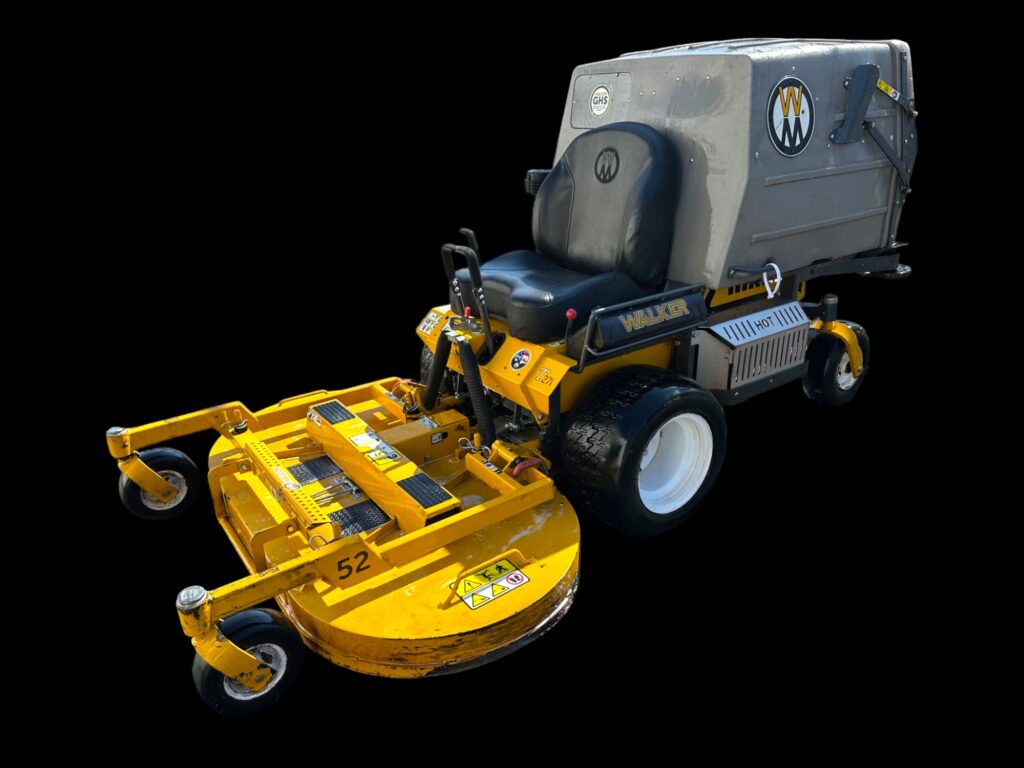
A Walker zero turn mower is a front-deck, commercial-grade machine built by Walker Manufacturing in Fort Collins, Colorado. Unlike mid-mount zero-turns where the deck sits under the frame, the Walker’s cutting deck extends out in front of the operator – a design that lets you trim tight to obstacles on both sides without leaving a missed strip along the edge.
The machine runs on dual independent hydrostatic transmissions with precision steering levers and a separate forward speed control. That combination gives it the tight turning radius of a zero-turn with a level of steering control closer to a walk-behind than a typical lap-bar mower.
The defining feature, though, is the integrated Grass Handling System (GHS) – more on that below.
How Much Does a Walker Zero Turn Mower Cost?
Walker zero turn mowers range from approximately $10,750 on the lower end to over $20,000 for a fully configured commercial model (AllMachines, 2026). Current dealer listings show new Model T27i units at $19,950–$20,650, while used examples with under 400 hours run $6,000–$10,000 depending on year and condition (TractorHouse, 2025; KanEquip, 2025).
Compare that to the competitive residential and near-commercial zero-turn market:
| Mower Category | Typical Price Range | Useful Life (Hours) |
|---|---|---|
| Box-store residential ZTR (Husqvarna, Cub Cadet) | $2,500–$4,500 | 200–500 hrs est. |
| Mid-grade residential ZTR (Toro Titan, Gravely ZT HD) | $4,500–$7,500 | 500–1,000 hrs est. |
| Near-commercial ZTR (Hustler Raptor, Ferris ISX) | $6,000–$10,000 | 1,000–2,000 hrs est. |
| Walker zero turn (new) | $10,750–$21,000+ | 2,000–3,500+ hrs est. |
The Walker sits in a different pricing tier. That gap is the central question for any homeowner.
What Makes the Walker Different from a Cheaper Zero-Turn?
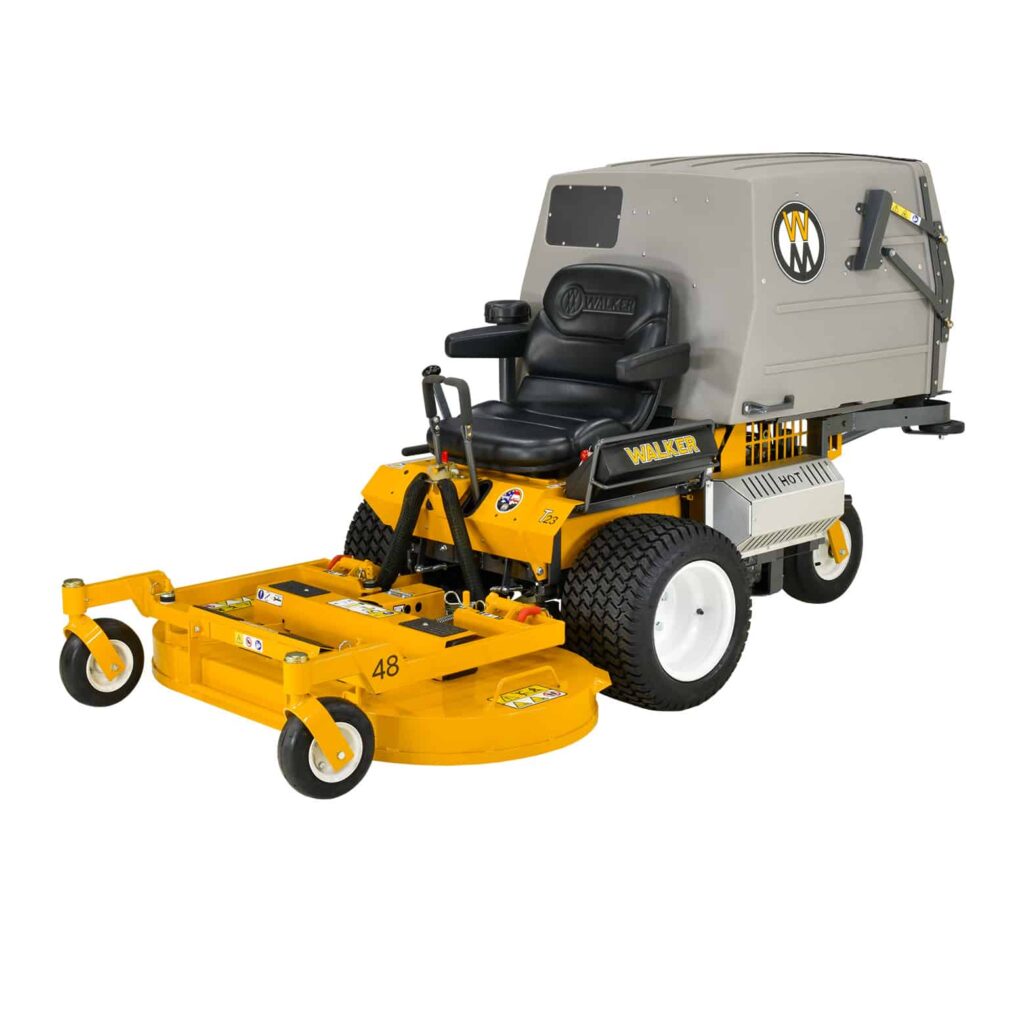
The Walker’s GHS (Grass Handling System) is the machine’s clearest differentiator. It is a built-in vacuum collection system that sits entirely within the mower’s footprint – no external tubes, no bags hanging off the back, no bulk extending past the frame. The GHS blower pulls clippings from the front deck directly into a 10-bushel rear catcher using powerful vacuum action (Walker Manufacturing, 2024).
The practical result: after you mow, the lawn looks like it was vacuumed. Clippings, leaves, and debris disappear rather than sitting on top of the grass. For homeowners who bag every cut, this is the difference between 30 minutes of cleanup and none.
Three other things separate it from most residential machines:
- Front deck design allows trimming on both sides of the cutting deck, so you can edge right up to beds, fences, and trees without a separate pass.
- Tilt-open body exposes the engine, belts, and drivetrain in seconds for maintenance – no crawling underneath.
- Commercial chassis uses an all-welded frame built from 3/8″ x 2″ steel, with Kohler Command Pro or EFI engines that are designed to run thousands of hours under daily commercial use (Walker Manufacturing, 2024).
The GHS also handles leaves in fall and can run attachments including a snowblower, dozer blade, and dethatcher – making it a year-round machine rather than a seasonal one.
Walker vs. Cheaper Zero-Turns: The Honest Comparison
The Walker is not the fastest mower in the $10,000+ category. A mid-mount commercial zero-turn from Ferris or Hustler will cover ground faster, particularly on wide open turf. The Walker’s front deck design and GHS add mechanical complexity, and the mower is slower by design – it prioritizes finish quality over speed.
Here is where the Walker wins and where it does not:
| Factor | Walker ZTR | Residential/Mid-Grade ZTR |
|---|---|---|
| Cut and collection quality | Best in class – carpet-like finish | Good to very good |
| Trimming precision | Trim both sides of deck | Typically one side only |
| Bagging system | Integrated GHS, no external bulk | External bagger add-on or none |
| Mowing speed | Slower (GHS adds load) | Faster on open ground |
| Hillside performance | Below average – poor on steep slopes | Better on most grades |
| Attachment versatility | Snowblower, cab, dozer blade, dethatcher | Limited or none |
| Purchase price | $10,750–$21,000+ | $2,500–$10,000 |
| Expected lifespan | 2,000–3,500+ hours with care | 200–1,500 hours depending on tier |
The hillside limitation is real and frequently cited by Walker owners. If your 1-3 acres includes significant slopes, this is not the right machine regardless of budget (Lawnsite user forums, 2011).
Who Should Seriously Consider a Walker?
Credit: https://www.coastlinemowers.com.au/
A Walker zero turn makes sense for a homeowner who checks most of these boxes:
- You bag every cut and currently spend extra time raking or blowing clippings off beds, paths, and driveways.
- Your lawn has lots of obstacles – beds, trees, fencing – where trimming precision matters more than raw speed.
- You want one machine that handles mowing, leaf cleanup in fall, and possibly snow removal or dethatching in other seasons.
- You intend to keep the mower for 15–20 years and want commercial-grade durability rather than replacing a residential unit every 5–8 years.
- Your property is mostly flat. Walker mowers handle gentle grades fine but lose traction and stability on steeper terrain.
If your lawn is relatively open, you side-discharge or mulch instead of bagging, and you want to spend under $7,000, a Toro Titan, Gravely ZT HD, or Hustler Raptor SD will serve you well for years without the Walker’s complexity or price tag.
Common Mistakes Homeowners Make When Considering a Walker
- Buying used with high hours without inspection. Walker mowers can run well past 2,000 hours when maintained, but a neglected machine with worn hydrostats and a damaged blower is an expensive repair bill. Check the deck condition closely – normal wear can damage a deck by 1,200 hours on a hard-used unit (Lawnsite, 2011).
- Overlooking the wet-grass clogging issue. The GHS system can clog in heavy, wet clippings. This is a known limitation. If you mow frequently in wet conditions, budget time for clearing the blower.
- Expecting it to outrun a mid-mount ZTR. It will not. The Walker wins on finish, collection, and versatility – not acres-per-hour on a wide open lot.
- Ignoring dealer proximity. Walker is a dealer-service brand, not a box-store brand. Parts availability and local dealer support matter far more here than with a machine you can take to any small engine shop.
Frequently Asked Questions
How much does a Walker zero turn mower cost?
New Walker zero turn mowers range from about $10,750 to over $20,000 depending on the model and configuration (AllMachines, 2026). Used units in good condition with 300–500 hours typically sell for $5,000–$10,000 through dealer resale and equipment listings (TractorHouse, 2025).
Is a Walker mower worth it for a homeowner with 1-3 acres?
It depends on how you mow. If you bag every cut, have a property with a lot of obstacles to trim around, and want a machine that lasts 15–20 years, the Walker’s cut quality and GHS collection system justify the price. If you mulch or side-discharge on a relatively open lot, a residential or near-commercial zero-turn in the $4,500–$7,500 range does the job for much less.
How long does a Walker mower last?
Well-maintained Walker mowers routinely reach 2,000–3,500 hours, with some Kohler-powered units documented at over 3,000 hours in commercial use (Lawnsite forums). By comparison, box-store residential zero-turns are typically designed for 200–500 hours of use before major issues develop (TractorByNet forums).
Can a Walker mower handle hills?
Not well. Walker mowers are known for poor hillside performance due to their front-heavy design and rear-weighted catcher when full. They handle gentle grades without issue, but steep slopes are a genuine limitation. If your property has significant grade changes, a mid-mount zero-turn with a lower center of gravity is a safer and more capable choice.
What is the Walker GHS and why does it matter?
The GHS (Grass Handling System) is Walker’s integrated grass collection system built entirely within the mower’s frame. It uses a large blower to vacuum clippings from the front deck into a 10-bushel rear catcher, with no external tubes or bags. The result is a cleaner finish than any bagged mid-mount zero-turn, and the system handles leaves and debris in fall as effectively as it handles grass clippings in summer (Walker Manufacturing, 2024).
What happens if I skip annual maintenance on a Walker?
Walker mowers have more moving parts than a standard mid-mount zero-turn – belts, blower, GHS components – and they need regular attention to stay reliable. Skipping oil changes, air filter service, and blower inspections accelerates wear on the GHS blower and hydrostatic transmissions, which are the most expensive components to replace. Treat it like the commercial machine it is: service it every season.