Hidden Reasons Your Grass Keeps Dying in Spots (And How to Fix Each One)

TL;DR
- Patchy dead grass is rarely just a watering problem — the most common hidden causes are soil compaction, grub damage, buried construction debris, dog urine, and mower scalping
- Grub infestations affect roughly 40% of US lawns at some point and cause turf to pull up like loose carpet (University of Kentucky Extension, 2023)
- A simple tug test, a screwdriver probe, and a close look at patch shape can tell you which problem you have before you spend a dollar on seed or fertilizer
- Most spot-death problems are fixable without a landscaper — but you need the right diagnosis first
- Reseeding a dead patch without fixing the root cause is the single most common homeowner mistake
Why Diagnosing Patch Shape Is the First Step

The shape and location of a dead patch tells you more than any product label will. A round, bleached-out patch near a fence line points to dog urine. An irregular streak following your mowing path points to scalping. A soft, spongy patch that lifts off the soil like a doormat points to grubs underneath.
Before you buy anything, spend five minutes looking at the patch from different angles. Note the shape, the edges, and whether the surrounding grass looks healthy or just slightly stressed.
Soil Compaction: The Problem That Hides Under Every Footpath
Compacted soil is the most overlooked cause of recurring dead spots, especially in high-traffic areas. When soil particles are pressed together too tightly, grass roots can’t get air, water, or nutrients — they suffocate and thin out over a season or two.
You can test for compaction in 30 seconds. Push a standard screwdriver into the soil at the dead spot. If it stops before 2 inches, your soil is compacted. If it slides in easily to 4-6 inches, compaction isn’t your problem.
The fix is core aeration — a process that pulls small plugs of soil out of the ground to open up space for roots. A walk-behind core aerator rental from Home Depot or Lowe’s runs about $70-$90 per day (Home Depot Tool Rental, 2024). One pass in early fall on cool-season grasses, or late spring on warm-season grasses, is enough for most lawns.
Buried Construction Debris: The Cause Nobody Expects
Many homes built in the 1970s through the 1990s have concrete chunks, lumber scraps, or drywall buried just below the lawn surface — leftovers from the original construction that were never removed. Grass grows fine until roots hit the debris layer and can’t go deeper. Then the spot dies every summer when heat stress hits.
If your dead patch is in the same location every year, doesn’t respond to watering, and sits near where your house, a patio, or an addition was built, dig down 6-8 inches with a spade. You may find the answer immediately.
The only fix is removal. Dig out the debris, backfill with quality topsoil mixed with compost, and reseed.
Grub Damage: The Underground Pest That Pulls Turf Apart
White grubs — larvae of Japanese beetles, June bugs, and masked chafers — feed on grass roots from midsummer through early fall. The turf dies from below. By the time you see the brown patch, the roots are already gone.
The diagnostic test is simple: grab a handful of turf at the edge of the dead spot and pull. If it lifts cleanly off the soil like a piece of loose carpet, grubs are almost certainly the cause. Peel back a one-square-foot section and count the larvae. Five or more grubs per square foot is enough to cause visible damage (Penn State Extension, 2022).
Treatment timing matters more than product choice. Preventive grub control products — like those containing imidacloprid — work best applied in late spring to early summer, before eggs hatch. Curative treatments containing trichlorfon work after grubs are already active but must be watered in deeply within 24 hours.
Dog Urine Spots: Predictable Shape, Easy Fix
Dog urine deposits a concentrated nitrogen hit that burns grass at the center while sometimes creating a green ring at the outer edge — the fringe gets a mild fertilizer effect while the center gets scorched. The patches are almost always round, 4-8 inches across, and appear in the same general areas your dog uses most.
The fix isn’t complicated. Flush the spot with water immediately after your dog urinates — dilution is the only reliable prevention. For existing dead spots, rake out the dead material, apply gypsum to help neutralize soil salts, and reseed with a perennial ryegrass or tall fescue blend, which recovers faster than Kentucky bluegrass in high-traffic zones.
Mower Scalping: The Pattern That Shows Up in Straight Lines
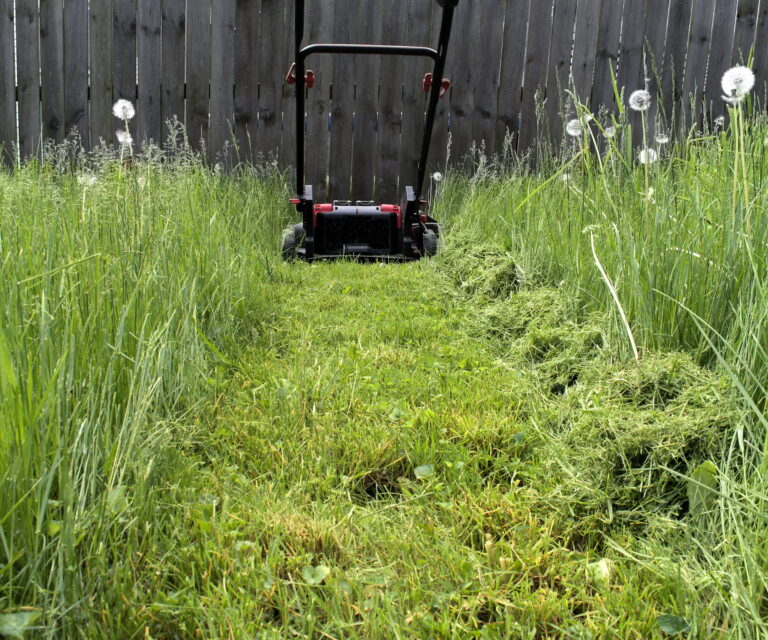
Scalping happens when mower blades cut too low and shave the growing point off the grass plant. The grass can’t recover and dies in strips or broad patches that follow your mowing direction. It’s common on uneven terrain, around tree roots that push the soil up, or when mowing deck height gets set too low accidentally.
Look at the dead area. If it follows a line or matches your mowing path, scalping is the likely cause. Check your deck height — most cool-season grasses should be cut at 3 to 3.5 inches, and warm-season grasses at 1.5 to 2.5 inches depending on variety (Purdue University Turfgrass Science, 2023).
If your lawn has high spots, topdress them with a thin layer of topsoil over several seasons to gradually level the surface. Don’t drop the deck to compensate for uneven ground — that makes the scalping worse.
Fungal Disease: When the Dead Patch Has an Irregular Edge and a Smoky Look

Fungal diseases like brown patch, dollar spot, and summer patch are active when nights stay above 70°F with high humidity — common in the Southeast and Mid-Atlantic regions through July and August. The patches often have irregular or water-soaked edges, and the grass blades themselves show discoloration at the leaf tips or a grayish, matted appearance at the center.
The practical test: look at the grass blades at the margin of the patch early in the morning before the dew burns off. Fungal issues usually show visible lesions, discoloration, or a thread-like mycelium on the blade surface.
Fungicide applications help but don’t fix the underlying conditions. Improve airflow, reduce evening watering, and avoid over-fertilizing with fast-release nitrogen in summer — that feeds the fungus.
What Fixes Patchy Grass for Good: A Comparison
| Cause | Diagnostic Test | Fix | Cost Estimate |
|---|---|---|---|
| Soil compaction | Screwdriver probe under 2 inches | Core aeration | $70-$90 DIY rental (Home Depot, 2024) |
| Buried debris | Dig 6-8 inches, check for material | Remove debris, backfill, reseed | Varies by depth |
| Grub damage | Tug test + larva count | Imidacloprid (preventive) or trichlorfon (curative) | $20-$40 per application |
| Dog urine | Round patch, green outer ring | Flush with water, gypsum, reseed | Under $20 |
| Mower scalping | Striped pattern following mow direction | Raise deck height, topdress high spots | $0-$30 |
| Fungal disease | Irregular edges, blade lesions | Reduce evening watering, fungicide if needed | $25-$60 per treatment |
Frequently Asked Questions
Why does my grass keep dying in the same spot every year?
Recurring dead spots in the same location almost always point to a structural problem in the soil — compaction, buried debris, or a drainage issue that doesn’t resolve on its own. Reseeding without fixing what’s underneath gives you the same result every season. Do the screwdriver test first, then dig if needed.
How do I tell if grubs are killing my grass?
Grab the edge of the dead patch and pull. Grub-damaged turf lifts off the soil cleanly because the roots have been eaten away. Peel back a square foot and count the larvae — five or more per square foot is a reliable damage threshold (Penn State Extension, 2022).
Can dog urine permanently damage grass?
Dog urine won’t permanently damage soil chemistry in most cases, but the same spot hit repeatedly can build up salt concentration over time. Flushing with water after every bathroom visit prevents most damage. For existing dead spots, gypsum helps break down the salt buildup before you reseed.
What is the best grass for high-traffic areas that bounce back from damage?
Tall fescue and perennial ryegrass recover faster from wear and spot damage than Kentucky bluegrass in most US climates. Bermudagrass is the best option for warm-season lawns in the South — it spreads aggressively and fills bare spots on its own.
Should I reseed or use sod to fix a dead patch?
For patches under 12 inches across, reseeding works fine if you fix the underlying cause first. For larger areas, sod gives faster coverage but costs more — typically $0.35 to $0.85 per square foot for sod versus $0.10 to $0.20 per square foot for quality grass seed (This Old House, 2024). Either way, if you skip the diagnosis step, the patch will come back.