How to Change Oil in a Lawn Mower: Step-by-Step Guide for 2026

TL;DR
- Changing oil in a lawn mower takes about 20 minutes and requires an oil drain pan, a rag, and the right oil for your engine.
- Most walk-behind mowers with Briggs & Stratton or Honda engines take SAE 30 for warm-weather use or 10W-30 year-round (Briggs & Stratton owner documentation, 2024).
- Run the engine for 2 minutes before draining so the oil is warm and flows out cleanly.
- Most small engines need an oil change every 50 hours of use or once per season, whichever comes first (Honda GCV owner’s manual, 2023).
- You don’t need a shop for this – a confident first-timer can do it in one driveway session.
What Oil Does a Lawn Mower Use?
Credit: automotivewidgets.com
Most standard walk-behind lawn mowers use SAE 30 oil for mowing season (above 40°F) or 10W-30 if temperatures swing cold in spring or fall. SAE 30 is the right call for summer mowing in most of the USA.
Check your owner’s manual first. Briggs & Stratton engines on mowers like the Craftsman M105 and many Troy-Bilt models specify SAE 30 for temps above 40°F (Briggs & Stratton engine oil guide, 2024). Honda GCV160 engines, found on the Honda HRN and many Toro Recycler models, also call for 10W-30 as a general-purpose option (Honda GCV160 owner’s manual, 2023).
Use a 4-stroke engine oil rated for small engines. Do not use 2-stroke oil in a walk-behind push mower.
What You Need Before You Start
Tools:
- Oil drain pan or a wide plastic container that holds at least 20 oz
- Clean rag or paper towels
- Funnel (narrow-tip works best for mower fill tubes)
- Adjustable wrench or socket set (only needed if your mower has a drain plug)
Parts and supplies:
- Fresh oil: SAE 30 or 10W-30, small-engine rated, 15-20 oz for most walk-behind mowers
- Replacement oil filter if your mower has one (most push mowers don’t; riding mowers do)
Safety steps:
- Disconnect the spark plug wire before doing anything mechanical on the mower deck.
- Let the mower sit on flat, level ground for the entire process.
- Never tip a mower with a full gas tank – gas will reach the air filter and carburetor.
Step 1: Warm Up the Engine So the Oil Flows Out Cleanly
Start the mower and let it run for 2 minutes, then shut it off. Warm oil is thinner than cold oil and drains much faster and more completely. Skipping this step leaves a thick, dirty residue behind that mixes into your fresh oil.
Step 2: Disconnect the Spark Plug Wire
Pull the rubber boot off the spark plug before you move the mower into drain position. This is the single step most DIYers skip, and it’s the one that matters most – a mower can fire if the blade catches on something while you’re working near it. Take 5 seconds and do it.
Step 3: Drain the Old Oil
There are two methods depending on your mower’s design.
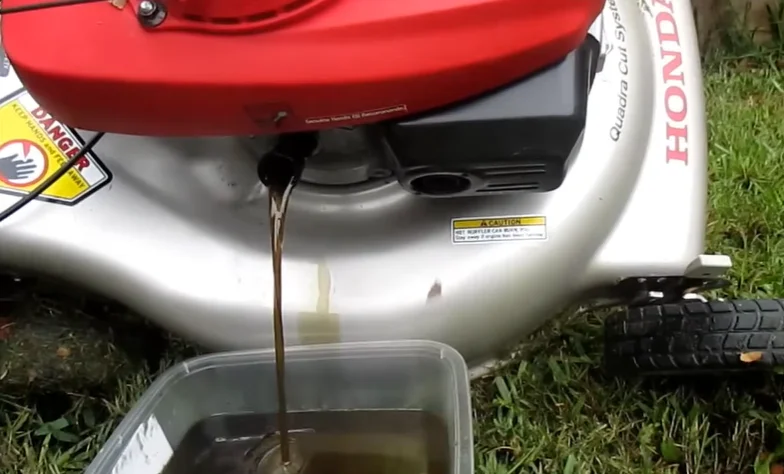
Drain plug method (riding mowers and some walk-behinds): Locate the drain plug on the underside of the engine, place your drain pan underneath, and remove the plug with a wrench. Let it drain fully – give it 3 to 5 minutes.
Tilt method (most push mowers): Remove the oil fill cap, position your drain pan on the left side of the mower, and tilt the mower toward the drain/fill tube. The oil pours out through the same tube you fill it from. Hold the tilt until the flow slows to a drip.
For the tilt method, always tilt with the air filter side facing up. Tilting the wrong way pushes oil into the air filter and carburetor, which turns a 20-minute job into a cleaning project.
Step 4: Replace the Oil Filter If Your Mower Has One
Most push mowers don’t have an oil filter. Riding mowers and larger engines – John Deere E100, Husqvarna TS 100, and similar – do. If yours has a filter, now’s the time to swap it. Hand-tighten the new filter after dabbing a little fresh oil on the rubber gasket. That gasket seal is what stops leaks.
Step 5: Refill with Fresh Oil
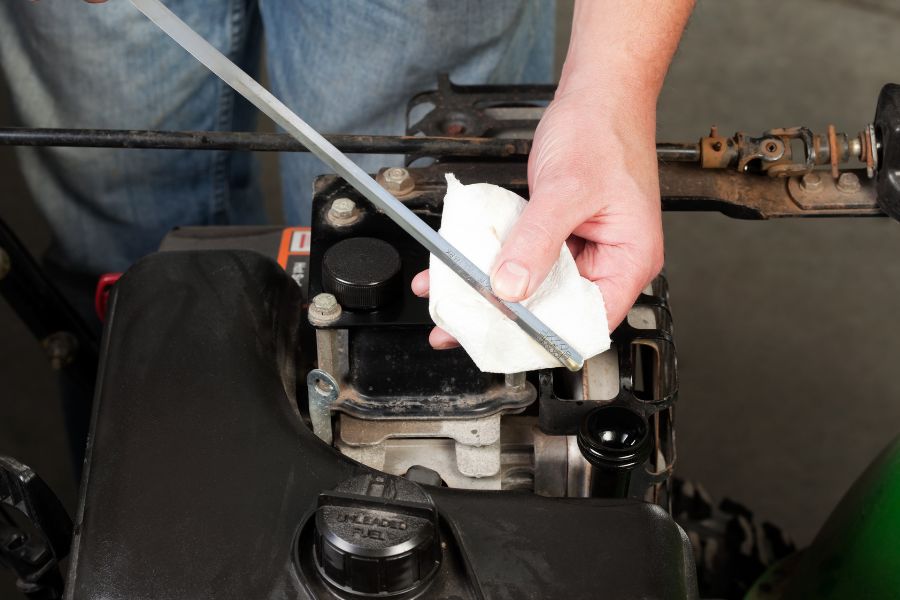
Replace the drain plug (if you removed one) and set the mower back on level ground. Use a funnel and pour in fresh oil slowly. Most single-cylinder walk-behind engines take 15 to 20 oz total (Briggs & Stratton engine specs, 2024). Check the dipstick after every few ounces – fill to the upper mark on the dipstick, not above it.
Overfilling is a real problem. Too much oil causes foaming, which loses lubrication and can blow oil out through the breather tube onto your air filter.
Step 6: Reconnect the Spark Plug Wire and Test
Snap the spark plug boot back onto the plug. Start the mower and let it run for 30 seconds. Check around the drain plug and fill cap for any drips. Shut it off, wait 60 seconds for the oil to settle, then pull the dipstick one more time to confirm the level is correct.
How Often Should You Change Oil in a Lawn Mower?
Credit: mowing.expert
Change the oil every 50 hours of operation or once per mowing season, whichever comes first (Honda GCV owner’s manual, 2023; Briggs & Stratton maintenance schedule, 2024). If you mow once a week for 30 minutes, you’ll hit 50 hours in about two seasons. Most homeowners should do it every spring as part of a season-opening routine.
For a brand-new engine, change the oil after the first 5 hours of use. New engines shed small metal particles during break-in, and you don’t want those circulating all season.
DIY vs. Shop: Is It Worth Doing Yourself?
Doing it yourself costs $5 to $8 in oil and takes about 20 minutes. A small-engine shop typically charges $25 to $50 for an oil change on a push mower, based on common regional shop rate estimates. The job is straightforward enough that there’s no skill barrier for most homeowners.
The only reason to use a shop is if you’re already bringing the mower in for other work, like a full seasonal tune-up, and want to bundle the services.
| Option | Estimated Cost | Time Required | Skill Needed |
|---|---|---|---|
| DIY oil change | $5-$8 (oil only) | 20 minutes | Beginner |
| Shop oil change only | $25-$50 (estimate) | Drop-off and pickup | None |
| Shop full tune-up with oil change | $60-$100 (estimate) | Drop-off and pickup | None |
What to Do If Something Goes Wrong
| Problem | Likely Cause | Fix |
|---|---|---|
| Oil won’t drain from tilt position | Mower tilted wrong way or not far enough | Tilt further, confirm you’re going toward the fill tube side |
| Oil level reads low right after refill | Oil hasn’t settled yet | Wait 60 seconds after shutdown, then recheck dipstick |
| Oil leaking from drain plug after job | Plug cross-threaded or not tight enough | Drain oil, clean threads, reinstall plug and tighten firmly by hand then a quarter turn with wrench |
| White or milky oil in drain pan | Water in the oil from condensation or a head gasket issue | If milky, don’t just change the oil – have a shop check for a head gasket leak |
| Mower smokes after oil change | Overfilled oil burning off | Drain a small amount until dipstick reads correctly |
Frequently Asked Questions
How often should you change the oil in a lawn mower?
Change it every 50 hours of use or once per season, whichever comes first (Briggs & Stratton maintenance schedule, 2024). New engines need a first oil change after just 5 hours to flush break-in metal particles.
What type of oil does a lawn mower take?
Most walk-behind mowers take SAE 30 for warm-weather use (above 40°F) or 10W-30 as a year-round option. Always check your owner’s manual – the engine label or manual will confirm the spec for your exact model.
Can you change lawn mower oil without a drain plug?
Yes. Most push mowers are designed to drain through the fill tube by tilting the mower on its side. Tilt with the air filter side facing up so oil doesn’t reach the carburetor.
What happens if you never change the oil in a lawn mower?
Old oil breaks down and loses its ability to lubricate the engine. Metal-on-metal wear increases, the engine runs hotter, and you’ll eventually seize the engine entirely – a repair that costs more than most mowers are worth.
How much oil does a push mower take?
Most single-cylinder push mower engines take 15 to 20 oz of oil. Check the dipstick as you fill rather than pouring in a set amount – mower oil capacity varies by engine size and model.
Quick Recap
- Warm up the engine for 2 minutes so the oil flows out fast and clean.
- Disconnect the spark plug wire before any mechanical work.
- Drain via the tilt method (most push mowers) or drain plug (riding mowers), always with the air filter side up.
- Refill to the upper dipstick mark with SAE 30 or 10W-30 – don’t overfill.
- Run the engine briefly, check for leaks, recheck the dipstick level, and you’re done.